
For Professional Investors Only
Rising single-stock volatility, a market that sells first and asks questions later, and the increasing influence of momentum-led strategies have led some investors to decide patience no longer pays. That’s the wrong conclusion, argues Alex Philipps.
Technologies that increasingly encourage our brains to scan, switch and simplify do not prime our minds for long-term investing. Instead, for the best part of fifteen years, they have been training us to shorten our attention spans in search of a quick dopamine hit rather than play the long game.
The effects of this are visible. Single-name volatility has risen. Stocks that miss quarterly numbers or simply drift out of favour with the market narrative get sold hard and fast. Retail trading flow represents a larger proportion of volume and tends to be shorter term and less value disciplined. Multi-manager pods are incentivised to deliver over ever shorter holding periods with little tolerance from their risk limits for holding through volatility. Passive flows keep funnelling capital into the same set of names regardless of price.
Put those ingredients together and a neat conclusion emerges – trade the volatility, follow momentum, shorten your time horizon, carefully manage tracking error and active risk and accept higher turnover because the market appears to have stopped rewarding patience.
Rising volatility gap between single stocks and broader market
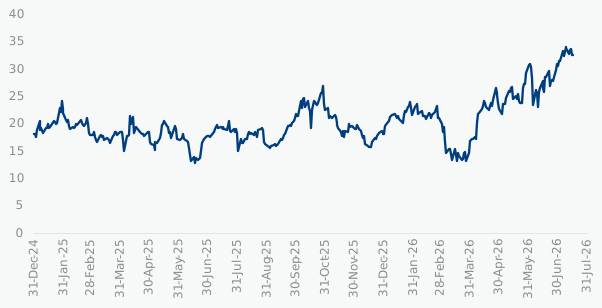
Line shows CBOE Volatility Index (VIX) minus CBOE S&P 500 Constituent Volatility Index (VIXEQ).
Source: CBOE, July 2026
“…over the long run, price and value reconnect; over the short run, they barely correlate.”
The inversion
This observation of markets may be correct, but the conclusion is backwards.
A market that has become shorter term does not make patience obsolete; it increases the competitive advantage of those who can remain patient. Benjamin Graham made the point nearly a century ago and the premise still holds – over the long run, price and value reconnect; over the short run, they barely correlate.
Has market structure changed? Yes, undoubtedly. But reacting by shortening investment time horizons sacrifices Graham’s key investment tenet and moves investors into a regime where analysis of the underlying business becomes less relevant. Or to put it another way, it means operating through an investment horizon where price is less connected to company fundamentals.
The busier and more reactive the market gets in the short term, the more that short-termism will dominate the mechanism for price setting. While this near-sightedness creates challenges, it also brings greater divergence and a more attractive time arbitrage opportunity for longer-term investors. This is not blind faith. A company that compounds free cash flow per share at 10% for five years will generate over 60% more cash flow per share in five years’ time. Even at a starting multiple of 18x, this company will generate a third of its starting market capitalisation in cash flow over those five years.
For growing businesses, price and value will not diverge forever. Patience can be rewarded, not just through fundamental growth, but also the potential kicker of a multiple re-rating should the market narrative shift.
“Our philosophy is simple – own good businesses, with stable or improving fundamentals, and don’t overpay.”
Discipline versus dogma
Given the strong operational and price returns in industries that we see as lower quality areas of the market or companies that appear expensive, how do we remain disciplined but not become dogmatic about what makes a quality business?
Our philosophy is simple – own good businesses, with stable or improving fundamentals, and don’t overpay. The process behind this is built upon a clear definition of what we believe makes a good business, namely sustainably high returns, predictability, an opportunity to grow and good capital allocation. Importantly, this is anchored in what is going on under the hood and what the future will bring, not the badge on the company door and past performance. Sectors and industries change, which makes it critical to neither dismiss nor favour parts of the market based on historic performance.
Not all companies will pass our strict criteria and nor should they. But in the narrowest market for a quarter of a century, with just 31% of MSCI World Index constituents outperforming the index in the second quarter, the relative cost of not owning the biggest winners is unusually high.
Furthermore, these winners are not just highly concentrated in number but also in their exposure to AI capex. Roughly 95% of the MSCI World’s return in the first half of 2026 was concentrated in semiconductors, technology hardware and capital goods. This creates an inherent conflict between a portfolio’s relative risk exposure and the risk of absolute value destruction. Minimising the former increases the latter and vice versa: lower tracking error comes at the cost of higher risk of absolute value destruction due to index concentration.
Such concentration of returns increases the relative cost of errors of omission. It also increases the likelihood of reaching what Jeremy Grantham calls the “point of maximum pressure” – the moment it feels hardest to keep your discipline and often the moment the market turns. We have already seen this leading to capitulation, with some managers closing and others engaging in process drift as portfolios are reshaped to close performance gaps by owning whatever has been working.
“…along with many others, we underestimated the speed and scale of the AI buildout.”
Evolution, not drift
Any such shift can be dressed up as evolution, but this needs to be clearly distinguished from the more pernicious process drift it can represent. A disciplined investment process should constantly evolve and improve but it must also be able to do the less comfortable thing – helping an investor stick to their knitting during periods when it feels hardest to do so. This is because these moments are often the point where forward returns are most attractive.
Both managers and allocators face the same dilemma. Selling an underperforming stock or redeeming from a disciplined but out-of-favour manager can look prudent in the moment, yet far less wise when price and value reconnect. A robust investment process is a critical tool to help protect against this error.
This should not require dogmatism or relying on reversion to the mean. The world and the industries therein are constantly changing, and AI has accelerated the pace of change. Along with many others, we underestimated the speed and scale of the AI buildout and how the shortage of key components would drive an almost unprecedented price cycle. This led us to either undervalue or misappraise the quality of some AI-related businesses – an error of omission.
However, errors of omission or commission are not the same as dogmatism.
Implementation improvements
How do we walk this tightrope? Firstly, by prioritising research on companies that should provide most diversification to the portfolio. This pushes us to remain open-minded. Secondly, by continually challenging our approach and assumptions. Thirdly, by always looking for ways to improve implementation and learn from our mistakes.
This year, we have evolved how we approach companies that underperform our operational expectations. In the current environment, operational mis-execution is being punished more severely by the market, making it even more important to act quickly if there are operational issues and to limit portfolio exposure to these types of situations.
We have also continued to supplement our human-led approach – the core of our investment process – with the rollout of automated quant tools that challenge our view. These tools feed external company data through our longstanding process to create a quantitative view on our three investment criteria – quality, fundamentals and valuation. Where those views differ from our own, the divergence is a prompt – not to act, but to better understand why we have a different view and pressure test our conviction.
Our assessment of the impact of AI continues to evolve, as does the market’s. The story of Alphabet over the last five years is instructive. It has yo-yoed between being perceived as an AI winner and loser, with its P/E ratio varying between 15x and 30x as the narrative has moved back and forth. The future for Alphabet is unlikely to be a straight line, but its vertically integrated approach to AI is unique, as is its ability to integrate its AI models into nine existing products with over a billion users.
We continue to look for companies like Alphabet where we are not ‘betting the farm’ on AI, but where it provides significant potential upside with an attractive valuation. On the flip side, we continue to focus on potential disruption caused by AI, weighing what appear to be attractive valuations against the risk of disruption for individual companies and the portfolio as a whole.
“Time is one of the most significant competitive advantages available to any investor.”
Time as the advantage
Investing through periods where patience is unfashionable is difficult. It requires discipline, resilience and a healthy dose of contrarianism, alongside a belief that the tortoise can outrun the hare.
Time is one of the most significant competitive advantages available to any investor. Unlike information or technology, it is one the market cannot arbitrage away. The market becoming structurally shorter-term does not eliminate this advantage; it merely concentrates it in fewer hands. This creates opportunities for those still willing and able to have the patience to use it and benefit from the inevitable longer-term reconnection of price and value.
About Longview Partners
Longview Partners is a specialist asset management firm, focused entirely on the management of global equity portfolios. Longview was founded in 2001 and serves an almost entirely institutional client base across North America, the UK, Europe, Australia and Asia. Longview’s robust investment process is disciplined, objective and consistent. Longview seeks to consistently generate long-term outperformance by investing in a concentrated portfolio of global equities through a team-based approach. They aim to invest in high quality companies with strong business fundamentals at attractive valuations. Longview Partners manages its Global Equity Strategy, the firm’s single product offering and sole focus.
Disclaimer
All performance data are in USD terms unless otherwise stated. Indices quoted are TR-Net.
The ‘Index’ refers to the MSCI World (USD)(TRNet).
The content of this document is meant solely for investment professionals and is intended for informational purposes only. You may not distribute this document, in whole or in part, without the express written permission of Longview Partners. This report does not constitute investment advice, a recommendation or an offer of solicitation. It may not be used as the basis for entering into or arranging any type of transaction.
Opinions expressed reflect our current opinion as of the date this information has been provided to you. Unless otherwise stated, the information set forth herein is unaudited. Such information is believed to be a true and accurate assessment as of the time stated but may be adjusted or modified at any time without prior notice or warning.
Longview specifically disclaims liability for any losses, damages incidental, consequential or otherwise, that may arise from use or reliance on any financial information contained herein by you or any other party for any reason including, without limitation, your use of such information in preparation of your own financial books and records. For further information please contact [email protected].
Longview Partners (Guernsey) Limited is licensed and regulated by the Guernsey Financial Services Commission.
Longview Partners LLP is authorised and regulated by the Financial Conduct Authority.
Longview Partners (Guernsey) Limited and Longview Partners LLP are each registered in the US with the Securities and Exchange Commission.
Longview Partners (Guernsey) Limited is exempt from the requirement to hold an Australian financial services licence under the Act in respect of financial services.