
For Professional Investors Only
Entranced by AI narratives and winner-takes-most economics, some investors have begun to question whether discounted cashflow-based valuation analysis is still fit for purpose. However, in the view of Longview Partners’ CEO, Marina Lund, it remains a key link between business strength and shareholder value.
A client recently asked whether discounted cashflow analysis is dead as an investment concept. While my response was a categorical ‘no’, the question says much about the investment conditions that produced it.
In recent years, equity markets have largely rewarded promise over the hard evidence of present cash generation. Businesses with an AI story, a platform claim or an option on technological change have attracted investors like bees to a honey pot, whereas stable, cash-generative companies have been treading water. In such environments, the discipline of assessing whether a business can convert revenue into long-term cash generation can start to feel outdated.
Déjà vu
Such conditions may seem eerily familiar. In 1999 and 2000, it was fashionable to argue that discounted cashflow analysis belonged to an analogue age. Analysts spoke of eyeballs, page views and first-mover advantage as though these were balance-sheet items. But whilst market exuberance today feels similar to 1999, some of the hottest stocks back then were furthest from generating any cash at all. Today, many of the higher growth companies have cashflows, but don’t have the long-term track record to give confidence on their longevity or predictability.
The notion that focusing on business quality and cash generation is outdated does not stand up to scrutiny. The idea long predates its modern packaging, descending from Benjamin Graham in the 1930s, whose tests for assessing a company concerned its quality rather than simply its price.i Nor is the approach only defensible in theory. MSCI’s sector-neutral quality indices have typically outperformed their global equity benchmarks since 1998, with lower risk.ii
The relative strength of quality has historically been widest precisely during episodes of serious turbulence.
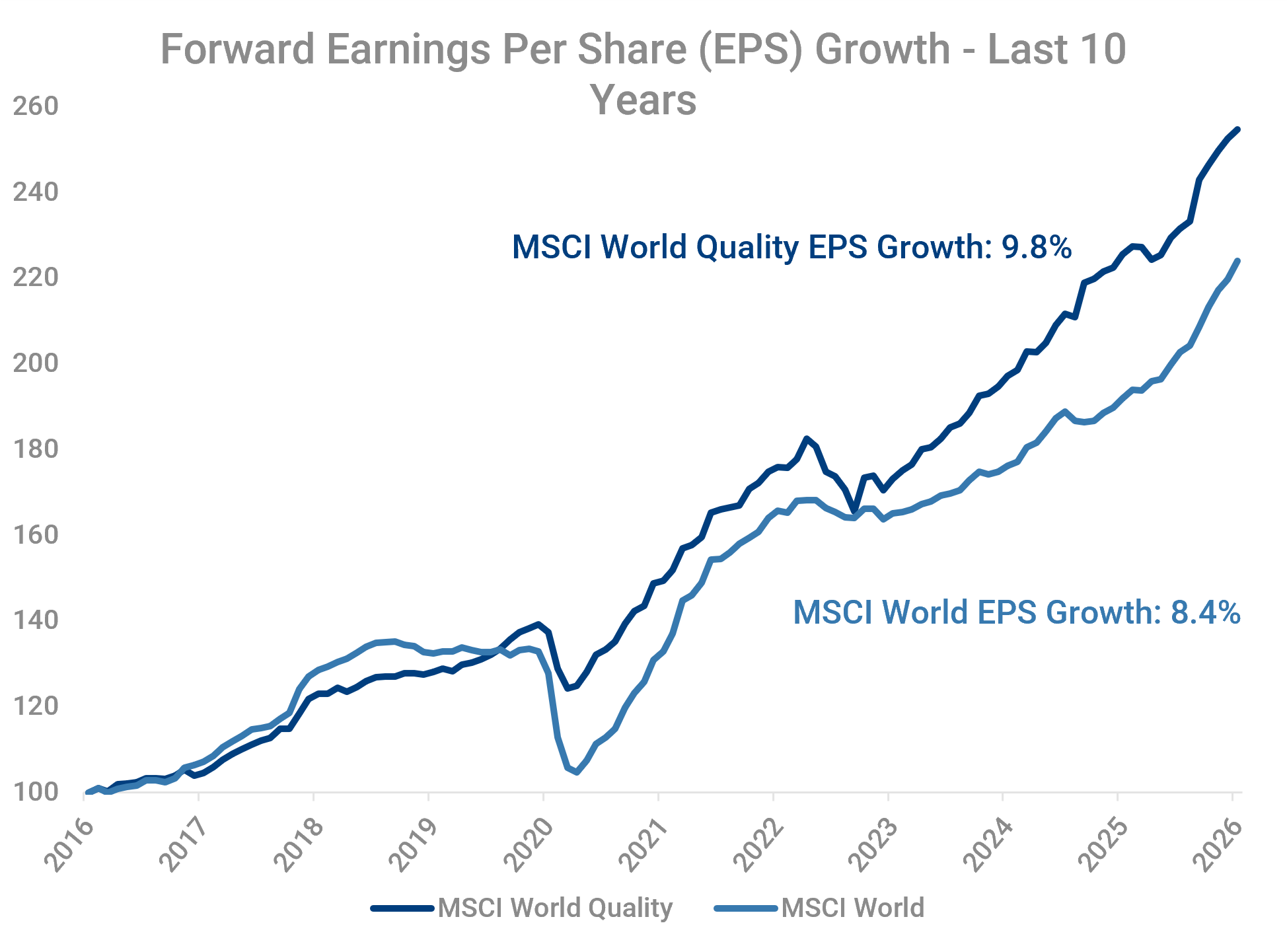
Consensus Next Twelve Months EPS provided for the MSCI World Quality (USD) and the MSCI World (USD). From 31 March 2016 to 31 March 2026. Source: FactSet, MSCI.
A fundamental truth
The technologies of the dotcom era were, of course, real. The internet reshaped the economy, with the eventual winners finding favour with investors by demonstrating durable economics and consistent cash generation.
This is a lesson worth holding onto. The case for cashflow does not rest on whether a narrative proves true but on what cashflow measures. Accounting earnings can be smoothed or flattered by market cycles, margins can be temporarily boosted by underinvestment and revenue growth can be bought.
Cashflow is harder to manufacture. It is a financial record of whether a business is genuinely self-funding – whether customers pay, whether pricing power is real, whether growth demands ever more investment to fund it and whether management allocates surplus judiciously. When share prices are largely driven by themes, cashflow helps investors separate what is observable from what is assumed.
“…cashflow helps investors separate what is observable from what is assumed.”
Risk matters
Cashflow is also important in another key context. When a single narrative becomes dominant, it stops respecting the boundaries investors use to organise risk. The assumption that AI will disrupt a given industry has been extended, with little discrimination, across enterprise software, data providers, information services and almost any business with intangible assets.
Sector and geography labels are too blunt to capture this. A company can be listed in one country and earn most of its cash somewhere else; it can sit in the same sector as another business while sharing almost none of its economic risks. A more useful question is which businesses would suffer value destruction from the same underlying event.
Cashflow analysis, applied at a portfolio level, is one of the few tools that can answer this. A collection of individually defensible holdings can still amount to a concentrated bet if too many holdings depend on the same future cashflows being able to survive the same disruption.
The answer to whether cashflow is dead today will be the same answer markets have arrived at every time the question has been asked before. Businesses that generate cash, allocate it well and compound their intrinsic value do not stop doing so because the market has temporarily lost interest. Sometimes it just takes time for them to be noticed again.
-
S&P Dow Jones Indices, Quality: A Practitioner’s Guide, January 2017.
-
MSCI, Repositioning for Slower Growth: The Case for Quality, December 2025.
Disclaimer
The content of this document is meant solely for investment professionals and is intended for informational purposes only. You may not distribute this document, in whole or in part, without our express written permission. This report does not constitute investment advice, a recommendation or an offer of solicitation. It may not be used as the basis for entering into or arranging any type of transaction.
Any references to past investment recommendations, market commentary, or specific securities are provided solely for illustrative or informational purposes. They do not constitute current investment advice, a solicitation to buy or sell any security, or an endorsement of any strategy. Performance or views expressed in historical materials may not reflect current market conditions and should not be relied upon for making investment decisions.
Any securities referenced may no longer be held, may never have been held, or may not form part of any current portfolio or strategy. Past performance is not a reliable indicator of future results, and all investments involve risk, including the potential loss of capital.
Opinions expressed reflect our current opinion as of the date this information has been provided to you. Unless otherwise stated, the information set forth herein is unaudited. Such information is meant to be a true and accurate assessment at the time stated but may be adjusted or modified at any time without prior notice or warning.
Longview specifically disclaims liability for any losses, damages (incidental, consequential or otherwise) that may arise from use or reliance on any financial information contained herein by you or any other party for any reason including, without limitation, your use of such information in preparation of your own financial books and records. For further information please contact [email protected]
Longview Partners (Guernsey) Limited is licensed and regulated by the Guernsey Financial Services Commission.
Longview Partners LLP is authorised and regulated by the Financial Conduct Authority.
Longview Partners (Guernsey) Limited and Longview Partners LLP are each registered in the US with the Securities and Exchange Commission.